What a mowing visit actually covers
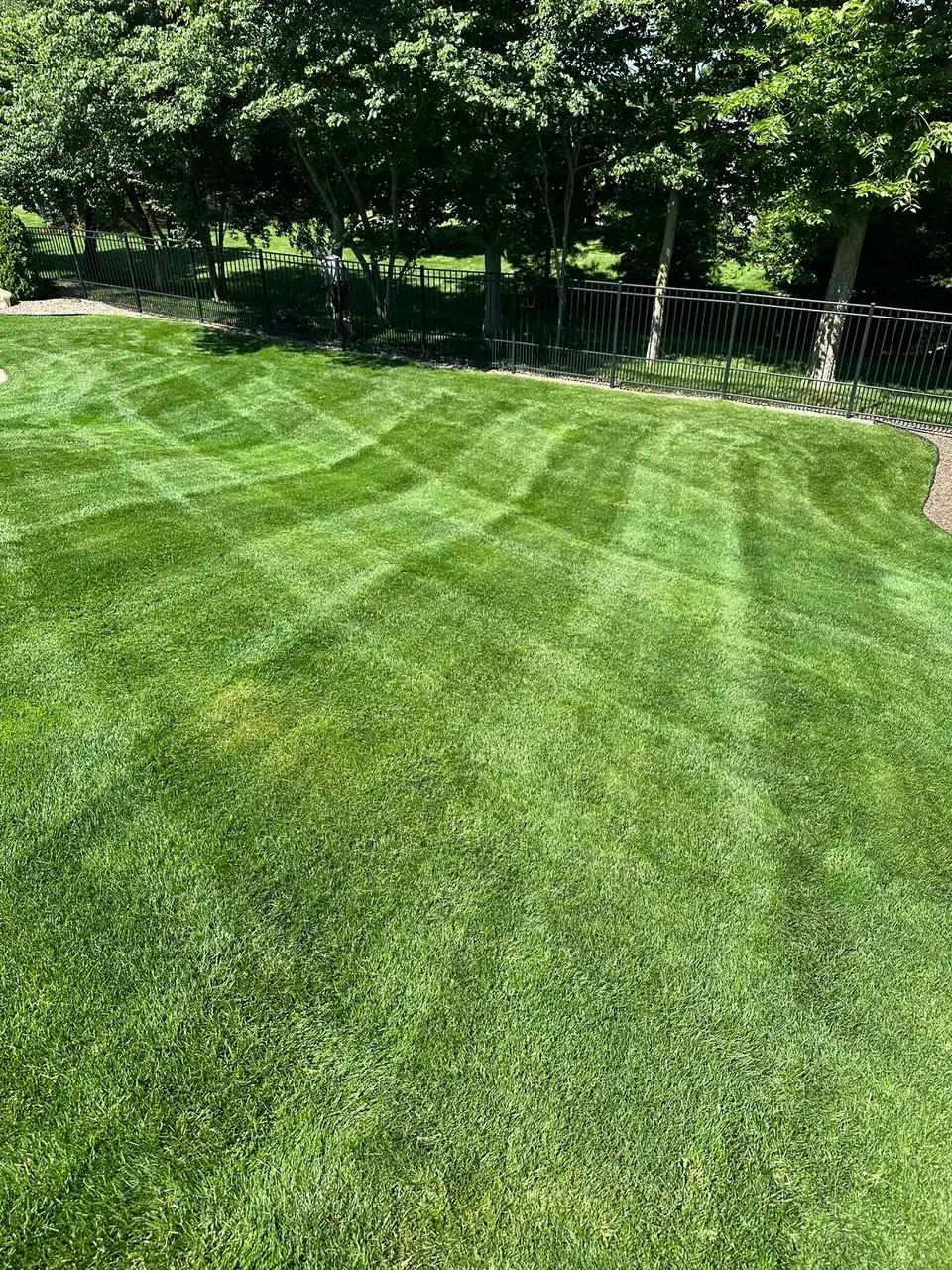
A visit is four jobs, not one. We mow the turf, trim everything the deck cannot reach, edge the hard surfaces, and blow the clippings off every walk, drive, and patio. Skipping any one of those is what separates a cut lawn from a finished one.
Trimming covers fence lines, foundation beds, mailbox posts, light poles, play sets, and around every tree. Edging is what gives a drive and sidewalk that hard line where the turf stops and the concrete starts. It is the single detail people notice from the road and the one most often skipped.
Why we alternate the mowing direction
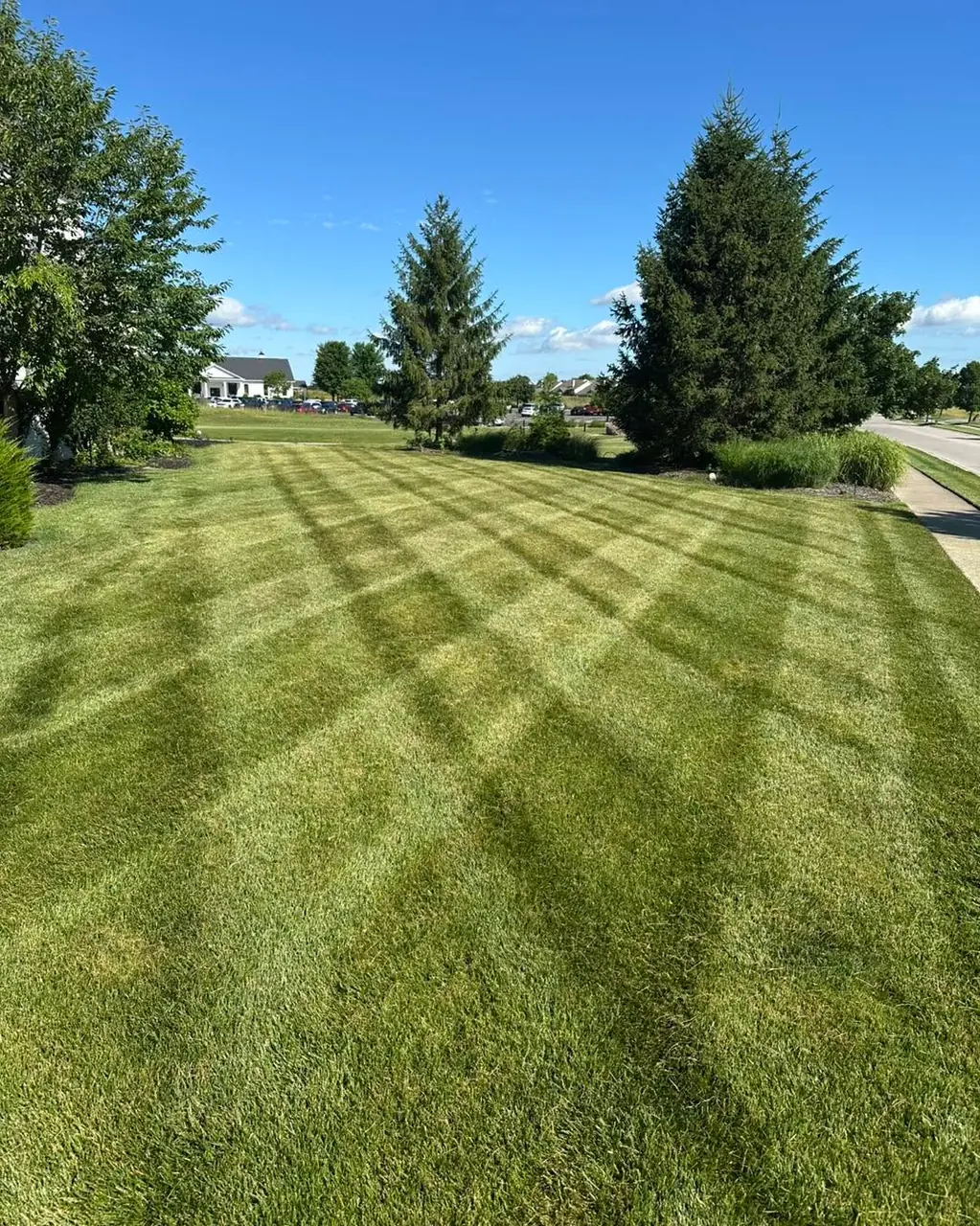
The stripes in a lawn are not two different cutting heights. They are the same grass bent in two directions, and the light does the rest: blades leaning away from you look pale, blades leaning toward you look dark. That is the whole trick.
Cutting the same direction every week causes two problems. The grass develops a grain and starts to lay over permanently, and the wheels run the same line often enough to press ruts into the soil. Ruts are much easier to avoid than to fix. Alternating the pattern each visit solves both, and it is why the stripe direction on your lawn changes week to week.
Cutting height, and why we do not scalp in July
Central Indiana sits in the transition zone, and most lawns here are cool-season grass: tall fescue, Kentucky bluegrass, perennial ryegrass, usually a blend. Those grasses grow hard in spring and fall and struggle in the heat of July and August.
We follow the one-third rule. Never take more than a third of the blade height in a single cut. Removing more than that shocks the plant, forces it to spend stored energy regrowing leaf instead of root, and opens the canopy so soil dries faster and weed seed gets the light it needs to germinate.
In summer we raise the deck. Taller grass shades its own root zone and holds moisture, which is exactly what a cool-season lawn needs in an Indiana August. A lawn cut short in midsummer browns out first and recovers last.
If your lawn goes tan in late July, that is usually dormancy and not death. Cool-season grass shuts down to survive heat and greens back up when temperatures drop and rain returns. We will tell you which one you are looking at rather than selling you a treatment for a lawn that is doing what it is supposed to do.
Sharp blades
A sharp blade slices the leaf. A dull blade tears it, and a torn leaf tip dries out and turns white or straw-brown within a day or two. If your lawn looks faintly frosted the day after it is cut, that is a dull blade, and the ragged wound is an easy entry point for disease.
We keep blades sharp on a rotation rather than waiting for the cut quality to drop off. It is unglamorous and it is most of the difference between a lawn that looks clean up close and one that only looks clean from the street.
Scheduling
Weekly is how we run. It is not an upsell: it is what keeps every cut inside the one-third rule, so we never have to take off more than the grass can afford in a single pass. Stretch the interval and you eventually face a choice between scalping the lawn or leaving it long, and both cost you.
Weekly service also means you get the same day each week, which matters more than people expect. You know when to move the cars, put the dog inside, and pick the toys up off the grass.
Biweekly is available if that suits your property better, and so are one-time cuts. A one-time cut covers the obvious cases: you have been away, the lawn got ahead of you, you are selling the house, or you just want to see the work before committing to anything ongoing. No contract either way.
Rain moves schedules. We do not cut saturated ground, because a mower on soft soil leaves ruts and the tires pull turf on the turns. When a day gets pushed, it gets pushed to the next dry day rather than skipped.
Common questions
- How often should a lawn in central Indiana be mowed?
- Weekly. Cool-season grass here grows fast enough through the season that a weekly cut is what keeps every pass inside the one-third rule, and it is what stops the lawn ever getting away from you. Weekly is our standard schedule for that reason.
- Do you offer biweekly or one-time cuts?
- Both. Weekly is the default because it is what keeps a lawn in the best condition, but biweekly is available if it suits your property, and we will do a one-time cut with no ongoing commitment. One-time cuts are common when you have been away, the lawn has got ahead of you, or you are getting a house ready to sell.
- Am I locked into a contract?
- No. Weekly service runs on an ongoing basis and you can stop it whenever you want. There is nothing to sign and no cancellation term.
- How do you get the stripes in the lawn?
- By bending the grass, not by cutting it at different heights. Blades pushed away from your eye reflect light and look pale, blades pushed toward you look dark. A roller behind the deck lays the grass over consistently, and mowing in straight alternating passes is what makes the pattern read cleanly.
- Do you bag the clippings or leave them?
- We mulch and disperse by default. Returned clippings break down quickly and put nitrogen and moisture back into the soil, which genuinely reduces how much fertilizer a lawn needs. We bag when the grass is long enough that clippings would sit in visible rows, after heavy rain, or in fall when leaf volume is high.
- Will you still mow if it has been raining?
- Not on saturated ground. Mowing wet soil leaves ruts that last all season and the tires tear turf on the turns, so a soaked yard gets moved to the next dry day. Damp grass after light rain is usually fine.
- My lawn turned brown in July. Is it dead?
- Almost always no. Cool-season grasses go dormant to survive heat and drought, turning tan from the top down while the crown stays alive. It greens back up when temperatures drop and rain returns. Dead turf pulls up easily with no resistance at the crown, and dormant turf does not. We will tell you which you have.
- Can you mow if there is a dog in the yard?
- Yes, as long as the dog is inside or secured while we are on the property. Let us know at the estimate and we will note it on the account. We close every gate behind us as a rule.
- Do I need to be home when you mow?
- No. Most of our regular accounts are not home when we come through. We only need reliable access to the gate for a fenced back yard.
- What happens to my schedule in the fall?
- The weekly visit carries on. Growth slows but leaf volume goes up, so the work shifts from cutting toward clearing. We keep coming until growth genuinely stops, which in Johnson County is usually somewhere in November depending on the year. Plenty of customers roll straight into snow service from there.
Mowing across Johnson & Morgan County
We run this service in every town we cover. Pick yours for what is specific to it.
Greenwood: Weekly cuts with the stripe direction alternated, across both the older tree-lined streets and the open subdivision lots. Franklin: Weekly through the season, with the height kept up under the canopy and a heavier fall schedule for leaves. Whiteland: Weekly service with the height kept up, which matters more on thin new-construction turf than on an established lawn.