Timing depends on what the shrub is
Spring-flowering shrubs set the buds for next spring during the previous summer. Lilac, forsythia, and viburnum all work this way. Cut them in late summer, fall, or winter and you are cutting off next year's flowers before they open. Those get pruned right after they finish blooming, which is a narrow window and the single most common mistake we get called to fix.
Shrubs that flower on new growth, like most hydrangea paniculata and spirea, are the opposite. They can be cut back in late winter or early spring before growth starts, and they will flower on what they push out that year.
Evergreens have their own timing. Boxwood, yew, and arborvitae are best shaped in late spring after the first flush of growth has hardened. Trimming evergreens late in fall pushes tender new growth that has no time to harden before frost, and that is the growth that browns out over winter.
Shape: wider at the bottom
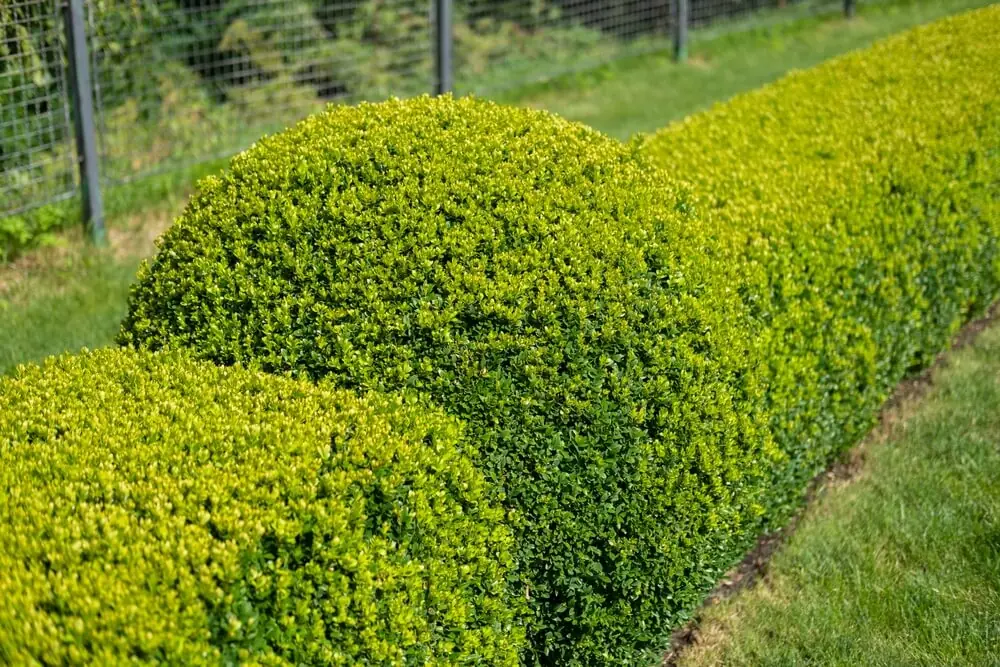
A hedge should be slightly wider at the base than at the top. It looks counterintuitive and it is the whole reason a hedge stays green to the ground.
Cut a hedge with straight vertical sides, or worse, wider at the top, and the upper growth shades everything beneath it. The lower branches get no light, drop their leaves, and go woody and bare. Once a hedge is bare at the bottom, getting it back takes years of hard renovation pruning, and some shrubs never come back at all.
A slight taper means light reaches the bottom branches every day. It is a small thing on any single cut and it decides what the hedge looks like in ten years.
How much to take at once
The safe limit on most shrubs is about a third of the growth in one session. Taking more shocks the plant, and on evergreens there is a harder limit: most conifers will not regenerate from old bare wood. Cut a yew or an arborvitae back past the green growth into the brown interior and that section simply stays brown.
Deciduous shrubs are more forgiving and many can be renovated hard over two or three seasons, taking a third of the oldest stems to the ground each year. That is how an overgrown lilac or forsythia gets brought back without losing it entirely.
Planting new shrubs and hedges
New hedges get spaced by mature width, not by how they look on planting day. Too tight and the plants compete, thin out where they touch, and hold moisture against each other.
In heavy clay the planting hole matters more than the plant. Dig a hole two to three times as wide as the root ball but no deeper than it, so the plant sits on undisturbed ground and does not settle below grade. A hole dug deep into clay and backfilled holds water like a bucket, and the roots sit in it.
Arborvitae is the default privacy screen around here, and it is worth knowing that deer eat it, particularly in winter and particularly on properties backing onto woods or open ground. Where deer pressure is real we will suggest something they leave alone rather than selling you a screen that gets stripped to head height by February.
Common questions
- When should hedges be trimmed?
- It depends on the shrub. Spring bloomers like lilac and forsythia get cut right after they flower, because they set next year's buds over the summer. Summer bloomers on new growth can be cut in late winter. Evergreens like boxwood and arborvitae are best shaped in late spring once the first flush has hardened off.
- Why is my hedge bare at the bottom?
- Almost always because it is as wide or wider at the top than at the base, so the upper growth shades out the lower branches. They lose their leaves, go woody, and stop producing. Trimming with a slight taper, wider at the bottom, keeps light on the lower branches and prevents it.
- Can an overgrown hedge be cut back hard?
- Deciduous shrubs usually yes, over two or three seasons rather than all at once. Evergreens are a different matter. Most conifers will not push new growth from old bare wood, so cutting a yew or arborvitae back past the green leaves a permanent hole.
- My shrubs did not flower this year. What happened?
- The most likely cause is a trim at the wrong time. If a spring-flowering shrub is cut in late summer, fall, or winter, the buds it set for the following spring are removed before they ever open. The plant is fine and it will flower again next year if it is left alone through the bud-setting window.
- How often do hedges need trimming?
- Formal hedges usually want two cuts a season to hold a crisp line, sometimes three on fast growers. Informal and natural-shaped shrubs are generally fine with one, timed to their flowering.
- Will deer eat arborvitae?
- Yes, readily, especially in winter and on properties near woods or open ground. Damage typically runs from the ground to about head height, which is as high as they reach. If you are planting a new screen where deer pressure is high, it is worth choosing something less palatable up front.
Hedges & Bushes across Johnson & Morgan County
We run this service in every town we cover. Pick yours for what is specific to it.
Greenwood: Established neighborhoods mean established shrubs, often overgrown into the windows and needing renovation over a couple of seasons. Whiteland: Young privacy screens planted along new lot lines, mostly arborvitae, which need shaping early to stay full at the base. Old Bargersville: Long-established hedges and specimen shrubs, shaped with a taper so they stay green to the ground.