What clearing usually involves
Most jobs start at a boundary. Fence lines, tree lines, the strip behind a shed, ditch banks, and the back edge of an acreage lot are where growth starts because that is where nothing is mowed regularly.
The work is cutting the growth down, getting the material off site, and then treating or removing what will resprout. That last part is what decides whether the job holds. Almost everything woody in Indiana comes back from a cut stump, usually with more stems than it had before.
Bush honeysuckle, the one that matters here
If you have a wooded edge in Johnson or Morgan County, there is a good chance the wall of green along it is bush honeysuckle. It is invasive, it is everywhere in central Indiana, and it is the single most common thing we clear.
It is easy to identify once you know the two tells. It leafs out weeks before anything native in spring and holds its leaves weeks later in fall, so in early spring and late fall it is the only green thing in the understory. Break a stem and it is hollow.
It spreads by berries that birds carry, and it forms a canopy dense enough to shade out everything trying to grow beneath it. Cutting it down alone accomplishes little: a cut stump resprouts vigorously and you get a multi-stemmed thicket where there was one plant. It has to be pulled or the stump treated at the cut.
Late fall is genuinely the best time to work on it. It is still green and taking nutrients down to the roots when everything native has gone dormant, so treatment is at its most effective and there is the least risk to the plants you want to keep.
Poison ivy
Poison ivy is common in exactly the places brush clearing happens: fence lines, tree bases, and woodland edges. Three leaflets, the middle one on a longer stalk, and on mature vines a hairy rope of a stem running up a tree trunk.
It is worth telling us if you know it is there. The oil stays active on tools and gloves, and it does not belong anywhere near a brush pile that gets burned, because the smoke carries the oil into the lungs. We do not burn cleared material for this reason among others.
What happens to the material
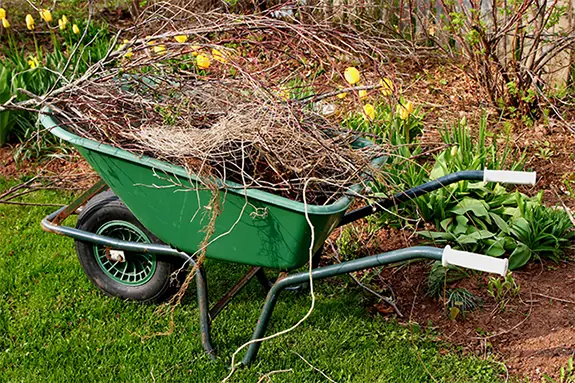
Cut material leaves the property. A brush pile left at the back of a lot is a nuisance, a home for exactly the wildlife you do not want near the house, and it kills the grass underneath it.
Larger jobs on acreage may be better handled by chipping on site, and if that is the cheaper answer for your property we will say so. For most residential clearing, hauling it off is simpler.
Common questions
- Why does brush grow back after it is cut?
- Because cutting removes the top and leaves the root system intact, and most woody plants respond by sending up multiple new stems from the stump. That is why a cut fence line often comes back thicker than it was. Holding the ground means pulling the root or treating the stump at the cut.
- How do I know if it is bush honeysuckle?
- Two easy tells. It leafs out well before native plants in spring and keeps its leaves well after they drop in fall, so in early spring and late fall it stands out as the only green in the understory. And the stems are hollow when you snap them.
- When is the best time to clear brush?
- Late fall through winter for most work. The leaves are down so you can see what you are actually dealing with, the ground is firmer, there are no ticks or mosquitoes, and honeysuckle treatment is at its most effective because the plant is still moving nutrients to its roots when natives have shut down.
- Do you burn the brush you cut?
- No. It leaves the property. Burning is restricted in much of the county, it is a genuine risk on a windy day, and if there is any poison ivy mixed into the pile the smoke carries the oil, which is dangerous to breathe.
- Can you clear a lot that has not been touched in years?
- Yes, and those are common. We walk it first, because what is under the growth decides the approach: old fencing, dumped material, stumps, and drainage all change the plan. Larger acreage may be better chipped on site than hauled, and we will tell you which is cheaper for your property.
- Will clearing damage the trees I want to keep?
- No. Clearing understory brush usually helps them, because invasive growth like honeysuckle competes hard for water and light at the root zone. We work around the trees you want kept and can flag anything already in poor condition while we are in there.
Brush Removal across Johnson & Morgan County
We run this service in every town we cover. Pick yours for what is specific to it.
Banta: The main reason we get called out here. Fence rows, ditch banks, tree lines, and honeysuckle that has taken the edge of a field. Mooresville: Fence rows, tree lines, and honeysuckle on the rural properties outside the town center. Franklin: Back lot lines and alley edges, and honeysuckle along the creek corridors.