How low-voltage systems work
Almost all residential landscape lighting runs at 12 volts rather than household 120. A transformer mounted near an exterior outlet steps the power down, and buried cable carries it out to the fixtures. Low voltage is safer to work around, the cable does not need to be run in conduit at depth the way line voltage does, and the fixtures are far easier to move later when a bed grows in.
The part that gets done badly is transformer sizing. Load every fixture onto a transformer with no headroom and the run at the far end dims, because voltage drops over distance and under load. We size for the fixtures on day one plus room to add, and we split long runs across zones instead of chaining everything into one line.
The three things light does to a house
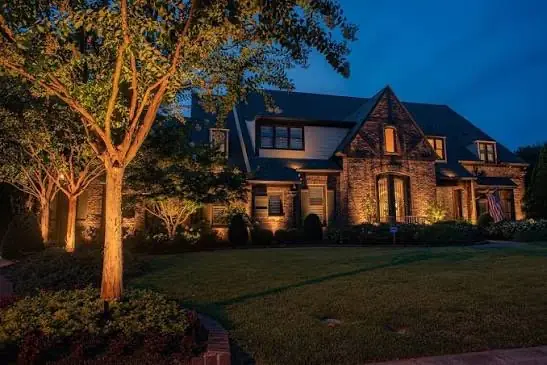
Uplighting puts a fixture at the base of a tree or a corner of the house and throws light up. It is what gives a mature tree presence at night and what makes a two-story facade read as tall rather than as a dark block.
Path lighting marks the walk and the drive. The common mistake is spacing them evenly like runway markers. Lights belong where the path does something: a turn, a step, a change in surface. Fewer fixtures, better placed, looks considered rather than decorated.
Washing runs light along a surface at a shallow angle to bring out texture. On brick, stone, and board-and-batten it is the difference between a lit wall and a flat one. On perfectly smooth siding it does very little, so we do not sell it there.
LED, color temperature, and why it matters
We install LED. The draw is a fraction of halogen, which means more fixtures per transformer, and the lamps last years rather than a season, which matters when a fixture is buried in a mature bed.
Color temperature is worth caring about. Warm white in the 2700K range flatters brick, stone, and wood, and reads as welcoming. Push up toward 4000K and the same house starts to look like a parking lot. We stay warm and we keep every fixture on the property at the same temperature, because mixed color temperature is the thing that makes a system look assembled out of whatever was on the shelf.
Repairs on an existing system
Most systems that stop working failed at a connection, not at a fixture. Cheap twist-on connectors corrode where they sit in wet soil, and once one goes the rest of that run drops out. We repair with waterproof connectors rated for direct burial.
The other common failures are a transformer that has lost its timer or photocell, a cable nicked by an edger or a shovel, and fixtures buried by beds that have grown over them in the years since install. All three are fixable without starting over, and we will say so rather than quoting a full replacement.
Common questions
- How much of my yard can one transformer handle?
- It depends on total fixture wattage and how far the runs go, not on yard size alone. LED draws so little that fixture count is rarely the limit. Distance is: voltage drops over a long run, and the far fixtures dim. We size the transformer with headroom and split long distances into separate zones.
- Will the cable be visible?
- No. Cable is trenched below the surface and comes up only at the fixture. In beds it runs under the mulch line, and across turf it goes deep enough to sit below where an aerator or edger reaches.
- Do the lights turn themselves on?
- Yes. A photocell brings the system up at dusk, and a timer shuts it down at whatever hour you want. Most people run until around 11pm. Systems can also be put on a smart plug or controller if you want to run it from your phone.
- Can you add to a system that is already installed?
- Usually. The question is whether the existing transformer has capacity left and whether the current runs can carry another fixture without dimming the line. We check both before quoting, and if the transformer is maxed out we will tell you that up front.
- How long do the fixtures last outdoors?
- Quality brass and copper fixtures last decades and develop a patina rather than failing. Cast aluminum is a reasonable middle. Thin plastic fixtures crack after a few Indiana freeze-and-thaw cycles, which is why the cheap kits from a big box store tend to look rough by year three.
- Do lights need anything done to them in winter?
- Not really. Low-voltage LED systems run through Indiana winters without a problem. It is worth clearing snow off fixture lenses and checking that plow or shovel work has not knocked anything out of aim, which is the most common winter damage we see.
Landscape Lighting across Johnson & Morgan County
We run this service in every town we cover. Pick yours for what is specific to it.
Greenwood: The larger west-side lots have the frontage and the mature trees that uplighting actually shows off. Old Bargersville: Mature trees and real frontage make this the part of the county where uplighting does the most work. Franklin: Older architecture takes uplighting and facade washing well, particularly on brick and stone.